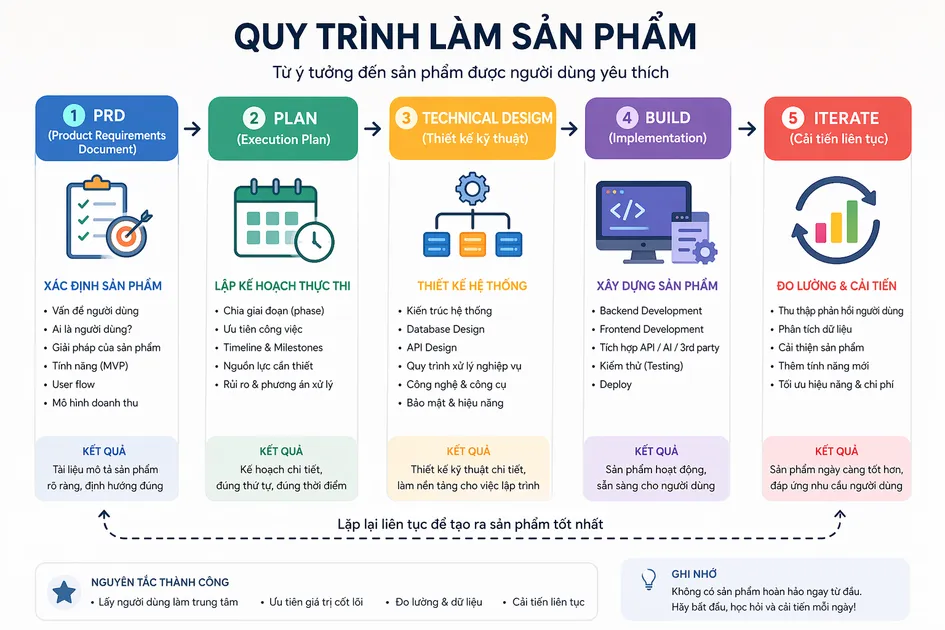
Product Development Process in the Era of Vibe Coding
Product Development Process in the Era of Vibe Coding
There is a paradox that anyone who has built products over the past few years will recognize: tools are getting stronger, code is being written faster, but the number of products that actually reach users — and are retained by them — has not increased accordingly.
AI can write a complete REST API in minutes. Cursor can scaffold an entire frontend with just a few prompts. But what gets left behind is not technical capability — it is product thinking.
Vibe coding frees you from writing code. It does not free you from having to think.
This article is not a new framework. This is how I look back at the PRD → Plan → Technical Design → Build → Iterate process after applying it in the context of AI-assisted development — and why each step now carries a different meaning than before.
1. PRD — Not a document, but a map of thinking
In a traditional environment, a PRD is often a heavy document that the team reads once and then leaves untouched in Notion. In the era of vibe coding, it plays a completely different role: it is the only thing that keeps you and AI from getting lost together.
When you prompt AI without a clear mental model of the product, what happens is not that AI creates the wrong thing — it creates something reasonable, but not what you need. That difference is subtle and extremely costly.
AI will always give you an answer. The question is whether you are asking the right question.
An effective PRD does not need to be long, but it must answer the most fundamental questions:
- Who the user is — not “everyone,” but a specific person with a specific problem
- What they are suffering from — a pain point big enough for them to change their habits
- What the MVP actually is — a clear boundary between “must-have now” and “nice to have”
- What the user flow looks like — from the first time they open the app to the moment they create their first value
The boundary of the MVP needs to be drawn before opening the editor, not while coding. Every feature you add that was not in the original PRD is a debt that must be paid — in time, in complexity, or in both.
2. Plan — Order matters more than speed
Nothing is more wasteful than doing very well something that does not need to be done right now.
Most products fail not because of a lack of capability, but because of the wrong order. The classic mistakes keep repeating:
Building UI before having a stable data model Implementing authentication before validating the core flow Optimizing performance before having the first user Building “interesting” features before building “necessary” ones
With AI, these mistakes become even easier to make, because everything can be generated quickly. That ease hides the more important question: does this need to be done right now?
A simple framework to check: if this feature is removed from the MVP, does the product still work? If yes — it is a phase 2 feature. This discipline, not coding speed, is what determines whether you ship an MVP or get stuck halfway.
A good plan does not need a Gantt chart or a complicated sprint. It only needs to clearly define: what each phase does, which milestones are checkpoints, and — most importantly — the logical order so that each step is built on top of the previous one.
3. Technical Design — The most skipped step, and the most expensive one
This is where vibe coding most easily creates an illusion. You can have a working application in a few hours. The database schema forms naturally through each prompt. API endpoints are added whenever needed. Everything looks fine — until it no longer is.
Bad system architecture does not kill a product immediately. It kills a product slowly — through bugs, refactoring costs, and the exhaustion of the person building it.
Technical design is not about drawing diagrams to make things look nice. It is the process that forces you to think ahead about the questions you will have to answer later, whether you want to or not:
How does data move through the system — from user input to the final output? When there are 10,000 records instead of 100, what will break first? How do the components in the system depend on one another — and can those dependencies become a single point of failure? Where is error handling processed, and when things fail, what does the user see?
For products with AI components — translation, summarization, content generation — this step is even more impossible to skip. Chunking strategy, queue design, retry logic, cost tracking: these are not later optimizations. They are the foundation. Skip them in week one, and you will have to rewrite the whole thing in week four.
4. Build — This is where vibe coding actually shows its power
Once the three steps above have been done seriously, the build phase becomes the experience people often describe when talking about vibe coding: fast, smooth, and almost enjoyable.
The reason is not that AI has become better. It is that you have given it enough context to do the right work.
A prompt written with an understanding of the data schema, API contract, and business logic will produce a completely different output from a prompt written in a vacuum.
At this stage, there are a few principles that help maintain momentum without losing control:
Commit by logic, not by emotion — do not push code just because it looks “done” Test assumptions early — deploy a rough version to 2–3 real users before polishing the UI Document technical debt — things you know are temporary need to be clearly marked, not forgotten Resist scope creep — every “small extra feature” carries hidden costs higher than it appears
The thing to remember: speed is the result of preparation, not the goal. Building fast on the wrong foundation only brings you to the rewrite point faster.
5. Iterate — Where the product is truly created
Your first version is a hypothesis, not a solution. The sooner you accept that, the more you learn.
No product is right from the beginning — this is not a comforting statement. It is a fundamental characteristic of the product development process, confirmed again and again by most successful products you know.
Iteration is valuable when it is guided by real data, not the founder’s intuition. The questions need to be answered with metrics:
- At which step in the flow do users drop off?
- Which feature do they look for but cannot find — and where do they look for it?
- How long does the average session last, and is it increasing or decreasing over time?
- Why do users come back — or do they not come back at all?
The founder’s intuition is often wrong here — not because the founder lacks experience, but because the founder is not the user. The gap between “what I think users need” and “what users actually do” is often much larger than expected.
In the context of vibe coding, the iteration cycle can be shortened significantly. An insight from user feedback can be tested in a few hours instead of a few days. But the value of that speed only appears if you have a system for collecting and interpreting feedback deliberately — not if you wait for users to email you on their own.
Looking back at the whole process
PRD → Plan → Technical Design → Build → Iterate is not a linear process. It is a loop, and with each loop, you understand the product and the users a little more deeply.
What AI changes is not the logic of this process — but the cost of each loop. When iteration becomes cheaper, you can run more loops. When building becomes faster, you can test more hypotheses.
But without a process, higher speed only means one thing: you go in the wrong direction faster.
What determines whether your product survives or disappears is not the tool you use. It is your ability to maintain clear thinking — about users, priorities, and the system — throughout the build process, no matter how much AI can do on your behalf.